ES Technical meeting
Menu

Bring your data to AI.
With European security.

The data infrastructure that enables AI to answer with the truth of your business: every answer traceable to its source data, every access governed and recorded, inside your private cloud.

In your cloudYour dataYour knowledgeNo access fees


Europe's data infrastructure for the AI era.

Opendome is mixed data infrastructure for structured and unstructured data, built on open source, with a security dome and access logging. The result: your AI behaves as if it were trained on all your data. It addresses three core challenges:

Challenge 1

AI-ready data

All your structured and unstructured data, centralized, connected in a semantic graph, and described. AI understands it instantly: higher-quality answers at a fraction of the cost.

−80%fewer tokens per query with prepared datasame question · same AI · no model change
Challenge 2

Governed access

Every AI query against company data is compiled and filtered against the defined access policies. The access event is written to an immutable log, ready for audit.

Challenge 3

Data sovereignty

Your company owns its data, not the hyperscaler hosting it. Opendome deploys the infrastructure in your cloud, in an open format: no provider dependency and no fee to access what is already yours. Under European jurisdiction and beyond the reach of the US CLOUD Act .

Why most AI projects never move beyond proof of concept.

This is not a model problem. It is an infrastructure problem.

01 — Effectiveness

Results are unreliable and difficult to predict.

The same "customer" is a different object in every system, and fields with similar names can carry different meanings. The same applies to tools. AI works with inconsistent information, fills gaps through inference, and returns generic or incorrect answers that no one trusts. Exposing MCPs does not solve it: the fragmentation remains.

95%

of generative AI pilots fail to deliver measurable P&L impact.

MIT · The GenAI Divide, State of AI in Business 2025
02 — Cost

Costs escalate and become unpredictable.

Without prepared data, AI reconstructs context for every task: it fills the context window, launches multiple calls and queries, and spends tokens inferring what it should be able to read directly. At scale, the overhead is substantial, rising, and difficult to budget.

≥50%

of generative AI projects will exceed their budget because of poor architectural decisions.

Gartner · Hype Cycle for Generative AI 2026
03 — Security

You cannot guarantee who accesses which data.

Roles work for people because human judgment provides the constraint: a person may have broad access but decides which data to use in each case. AI does not make that judgment; it uses everything the role grants. A role is therefore not enough: AI needs the exact data for the exact task, enforced by infrastructure. Nothing more.

97%

of organizations that experienced an AI-related breach lacked AI access controls.

IBM · Cost of a Data Breach Report 2025
04 — Compliance

You cannot audit who accessed which data, when, and for what purpose.

If GDPR, DORA, or EU AI Act compliance is a requirement for your organization, you need an atomic record of every access. Without that traceability, compliance cannot be demonstrated.

35 M€ / 7%

of global turnover: the maximum EU AI Act penalty, in force since 2024 and being phased in.

Regulation (EU) 2024/1689

How successful organizations deploy AI the right way.

Organizations that achieve real outcomes build the infrastructure first, then deploy AI on top of it with complete control.

Layer 1

Semantic Data Lake: all your data, ready for AI.

Structured and unstructured data, from transactions and contracts to calls, emails, and meetings, unified, connected, and semantically described. Everything that actually happens in your business, available to AI instantly.

Solves effectiveness and cost: reliable results using only the tokens required.

Layer 2

Security and observability dome: AI operating within its boundaries.

Atomic control over which data AI can access, for which task, and at what time. Every access is recorded. Any anomaly is blocked in real time. Not as configuration, but as an infrastructure guarantee.

Solves security and compliance: every answer contains exactly what the task justifies, and every access can be demonstrated to the regulator.

A business entity is more than fields in a database. It is its entire context.

Pre-AI transactional systems reduce the world to fields. But they do not understand the call where a customer raised concerns, the email where they made a request, the contract they signed, or the meeting where they changed their mind. Opendome brings data and content together to create exceptionally rich semantic graphs.

Proprietary innovation

Opendome brings structured data and every type of content together in a single semantic graph. The full context of every entity. Together. It is the component that makes the first layer possible.

Semantic graph Corpus ↔ entity anchoring

Everything an enterprise needs before deploying AI, in a single solution.

Opendome is the only platform that integrates the complete stack. The same two layers shown above, in detail: from data centralization and semantic modeling to atomic access control and auditable observability.

Layer 1 · Data lake

Data centralization and relationships

Every system, including CRM, ERP, and financial platforms, connected in a single data lake. Start with a customer identifier and instantly access any relevant data.

Layer 1 · Data lake

Unstructured data

Calls, video calls, emails, notes, and documents. Opendome unifies them with your structured data, adding the real-world context no form can capture.

Layer 1 · Data lake

Semantic layer for AI

AI works with data whose relationships, context, and meaning are explicit, instantly and without additional instructions or ambiguity across system naming conventions.

Layer 2 · Dome

Cell Model: atomic security

Every access is authorized across four dimensions: identity, task, entity, and exact field. One unique key per interaction. Enforced by infrastructure, not by a prompt.

Layer 2 · Dome

Auditable, immutable observability

Every action is recorded with its complete context. Append-only logging and full traceability. Compliance with regulations such as DORA and the EU AI Act by design.

The foundation

100% open source, with no vendor lock-in

Built on the same open-source technologies that power the internet and much of the US hyperscaler stack. No proprietary licenses. Your data remains in your cloud.

From fragmented data to governed knowledge, in eight stages.

The complete journey through both layers: data enters through connectors and is transformed with lineage along two parallel paths, identities for structured data and corpus plus metadata for content, which converge in a single data lake. There, knowledge is connected in the semantic graph and consumed under the dome through API and MCP, with policies already enforced.

01 · Connectors 02 · Data pipeline 03 · Identities 05 · Data lake 06 · Semantic graph 07 · Dome 08 · Consumption STRUCTURED DATA UNSTRUCTURED DATA API MCP person · AI · system answers with data lineage 04 · Corpus + metadata
View the complete flow, stage by stage →

A security dome designed for Europe's most demanding regulatory framework.

Data remains in your infrastructure. It never leaves your jurisdiction. Access logging is auditable by design, with no additional configuration.

GDPR

Privacy

Data residency in your jurisdiction and access minimization by design.

DORA

Resilience

Auditable access logging for financial entities and their technology providers.

EU AI Act

Artificial intelligence

Traceability and human oversight for high-risk AI systems.

ISO 27001

Security

Information security management aligned with the international standard.

ENS

Spain

Spain's National Security Framework for public bodies and their suppliers.

AGT-208scope · ticket.status+ GRANTEDAGT-X92scope · admin.payroll× DENIEDGDPR · DORA · EU AI Act · ISO 27001 · ENS

What US hyperscalers cannot give you.

Dominant solutions were built for a different world: data for human users. Opendome was designed from the ground up for the AI era and to meet European law.

Sovereignty

True data sovereignty, not a claim.

In the dominant model, data lives in the vendor's cloud, under its license and jurisdiction, and has been subject to the CLOUD Act since 2018. With Opendome, data resides in your infrastructure in an open format: sovereignty is a verifiable technical property, not a contract clause.

Cost

Predictable cost, no access toll.

Major vendors are shifting to headless models: they expose your system through APIs and charge for every operation AI performs against your own data. Entry is cheap; operation and exit come at a cost. With Opendome, data lives in your cloud in an open format, with no access toll or exit lock-in.

Compliance

Compliance by design, not by configuration.

On platforms designed before the EU AI Act, compliance is a configuration layer that someone must build and maintain. In Opendome, GDPR, DORA, and the EU AI Act are embedded in the architecture: atomic control and auditable logging exist without requiring configuration.

Architecture

Designed for AI, not retrofitted.

Existing platforms were designed for human users and have added AI layers on top. Opendome starts with the right question: what does AI need to operate autonomously on enterprise data?

Works with the AI you choose.

Opendome does not create or orchestrate AI. It is the data infrastructure that ensures your data is always protected and under your control.

Resources for teams making data and AI decisions.

Analysis, technical guides, and perspectives on data infrastructure, AI security, and European regulatory compliance.

Blog

AI memory is in the data

Business memory already exists: it lives in the data. The only memory that should belong to the agent is procedural.

Read
Blog

I'm an agent. This is what you do to me when you give me fifty tools

Connecting an agent to too many MCPs doesn't make it more capable: it makes it more expensive and less reliable. Half its capacity goes to loading tools, it chooses worse the more it has, and what we call "hallucinations" is almost always a data gap filled with inference. The key isn't more access: it's better data.

Read
Blog

You'll pay to access your own data

With agents that hold no seat and open no screens, per-user licenses stop making sense. Salesforce, SAP, and Microsoft are shifting to consumption pricing: charging for every operation an agent runs against the data. The problem is that you generated that data, and now operating on it costs.

Read

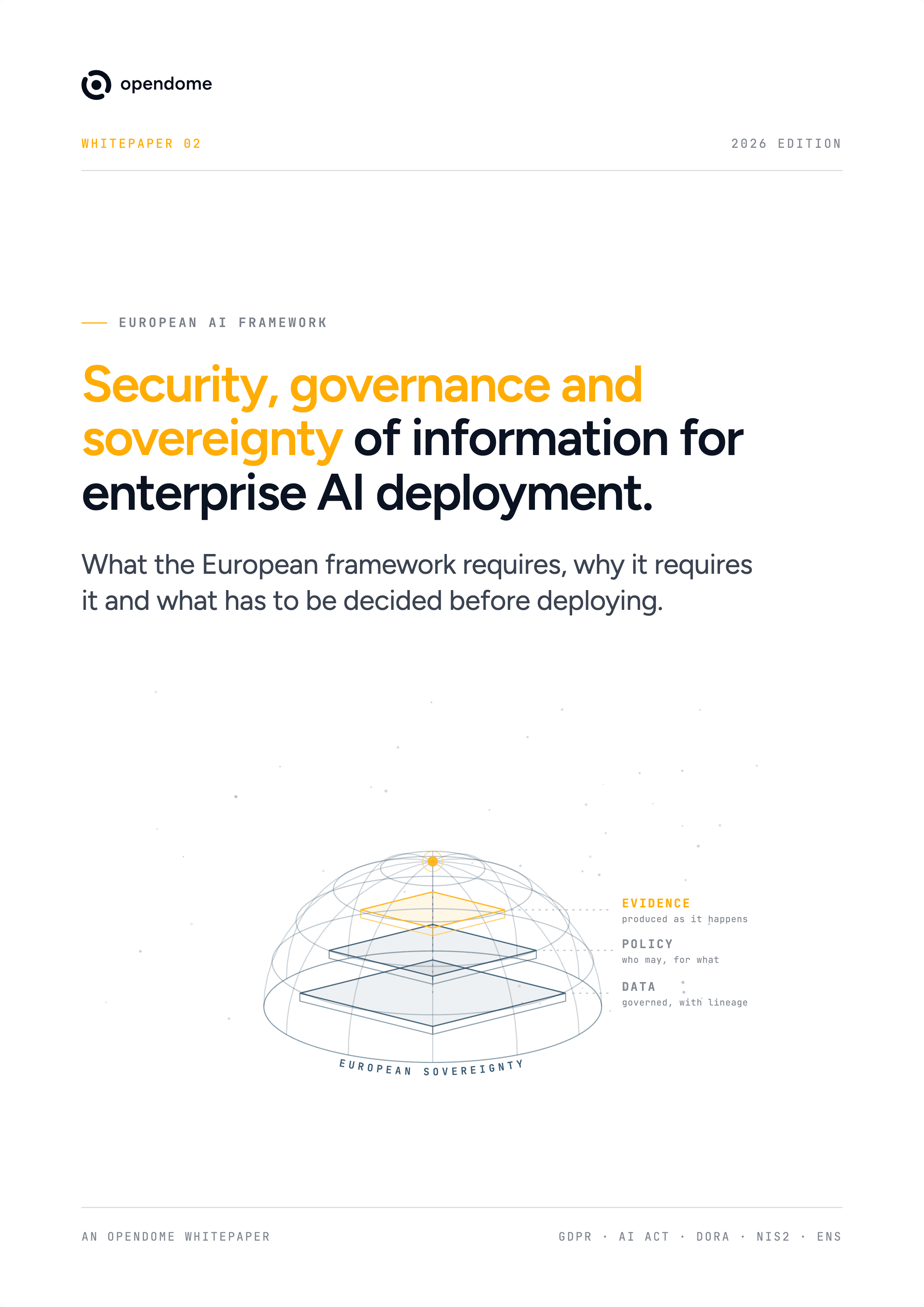
A detailed guide to understanding the European framework

We ask for minimal context. We process it in accordance with the GDPR.

Controller: OPENDOME, S.L. · Purpose: to handle your request and get the document to you; if you authorise it, to contact you and send you content. Legal basis: performance of your request and, for later sends, your consent. Retention: until you ask for erasure or withdraw your consent. Rights of access, rectification, erasure, restriction, portability and objection in the privacy policy. The form is processed on our own infrastructure hosted in the European Union and sets no cookies.